First of all, understanding the basic principle of speed control is the key. Speed control refers to keeping the moving speed of an object at a set value or changing according to a predetermined law through certain means. This process usually depends on the cooperation of sensors, controllers and actuators. The sensor is responsible for detecting the actual speed, the controller compares the actual speed with the target speed and sends an adjustment instruction, and the actuator adjusts the power output according to the instruction, thus realizing the speed adjustment.
The core of achieving smooth speed control lies in the “feedback adjustment” mechanism. Take the car cruise control system as an example. The system continuously collects the current speed through the speed sensor and compares it with the set speed. If there is deviation, the control system will automatically adjust the throttle or brake to restore the speed to the set value. This closed-loop feedback control mechanism can effectively deal with external interference and keep the speed stable.
Secondly, adopting advanced control algorithm is an effective means to improve the stability of speed control. Traditional PID (Proportional-Integral-Differential) control is widely used in various speed control systems. By adjusting three parameters, errors can be effectively eliminated, overshoot can be reduced and response speed can be improved. In recent years, with the development of artificial intelligence and automation technology, intelligent control methods such as fuzzy control and neural network control have also been introduced into the field of speed control, which makes the system still maintain good stability under complex and changeable working conditions.
In addition, the performance of hardware equipment also directly affects the effect of speed control. For example, the response speed of the motor, the accuracy of the transmission and the sensitivity of the sensor will all affect the stability of the overall control. Therefore, when designing and selecting the control system, the key components with high quality and precision should be selected to ensure the stability and reliability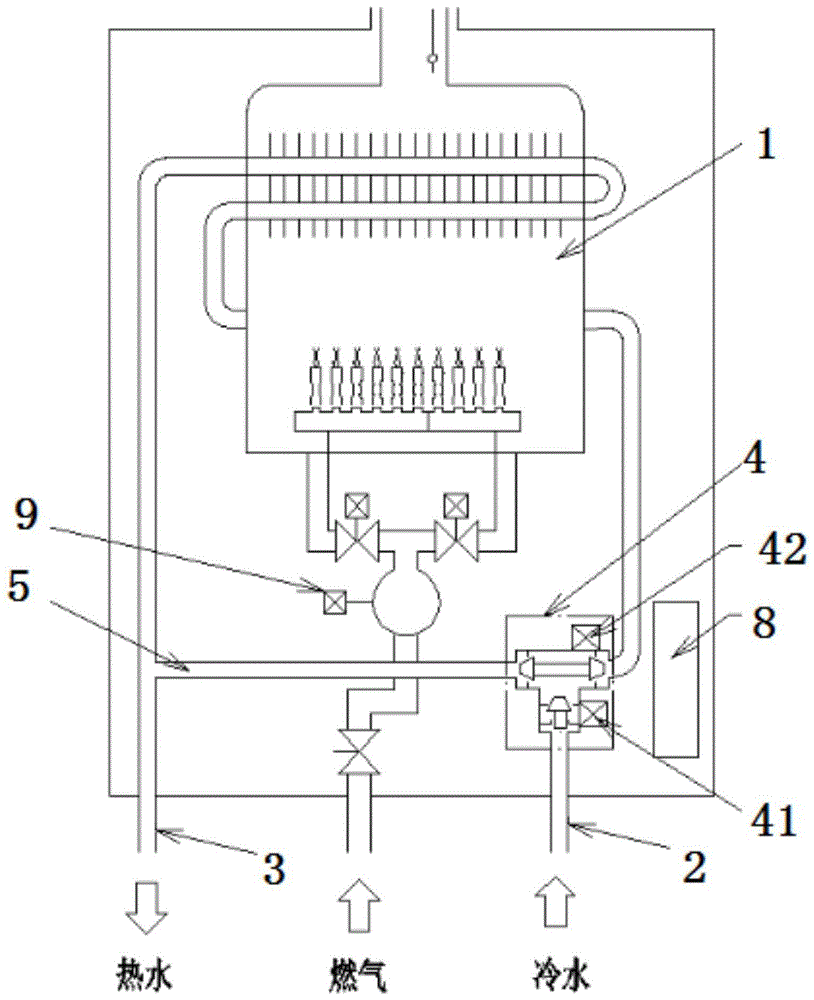 of the system.
Finally, the coordination between human operation and system design can not be ignored. No matter how high the degree of automation is, human judgment and intervention are still crucial. The operator should be familiar with the performance and limitations of the control system, and intervene manually when necessary to avoid speed out of control due to misjudgment of the system.
To sum up, to realize the stability of speed control, we need to comprehensively consider the system design, control strategy, hardware configuration and man-machine cooperation. With the continuous progress of science and technology, the future speed control system will be more intelligent and adaptive, providing safer and more efficient services for people’s travel, production and life.